Responsible tourism is no longer defined solely by the destinations we protect, it is equally shaped by the stories we tell about them. As travellers increasingly seek authentic, purpose-driven experiences, storytelling has become a powerful tool to build awareness, inspire responsible travel, and strengthen connections between people, culture, and the environment.
At RTSOI, we believe that innovation plays a vital role in advancing responsible tourism. Today, emerging technologies like Artificial Intelligence are opening new possibilities for destinations and tourism stakeholders to communicate sustainability in more engaging, accessible, and impactful ways.
One organisation exploring this potential is Pantellisense Pvt. Ltd., led by its Founder and CEO, Dr. Paras Prakash, whose work demonstrates how AI can be harnessed to create regenerative stories that encourage conservation, education, and community engagement.
Storytelling That Goes Beyond Promotion
For years, destination marketing has focused primarily on attracting visitors through beautiful imagery and memorable experiences. Responsible tourism, however, calls for a deeper approach, one that encourages travellers to understand, respect, and contribute positively to the places they visit.
Pantellisense’s concept of Eco-Tainment reflects this shift by combining engaging storytelling with environmental awareness. Rather than simply showcasing destinations, the approach uses immersive narratives to communicate the importance of conservation, local culture, and ecological responsibility.
It highlights how storytelling can evolve from a marketing tool into a catalyst for meaningful change.
AI as an Enabler of Responsible Tourism
Artificial Intelligence is rapidly transforming the way tourism content is created and shared. Beyond improving efficiency, AI presents an opportunity to reduce the environmental footprint traditionally associated with large-scale productions.
By minimising travel logistics, production resources, and operational requirements, AI-powered content creation offers a more sustainable way to develop compelling visual narratives while remaining aligned with responsible tourism values.
For destinations and tourism organisations, this represents an opportunity to tell richer stories while adopting more environmentally conscious methods of communication.
Creating Lasting Engagement Through Innovation
One of the strengths of regenerative storytelling lies in its ability to engage audiences across multiple platforms and generations.
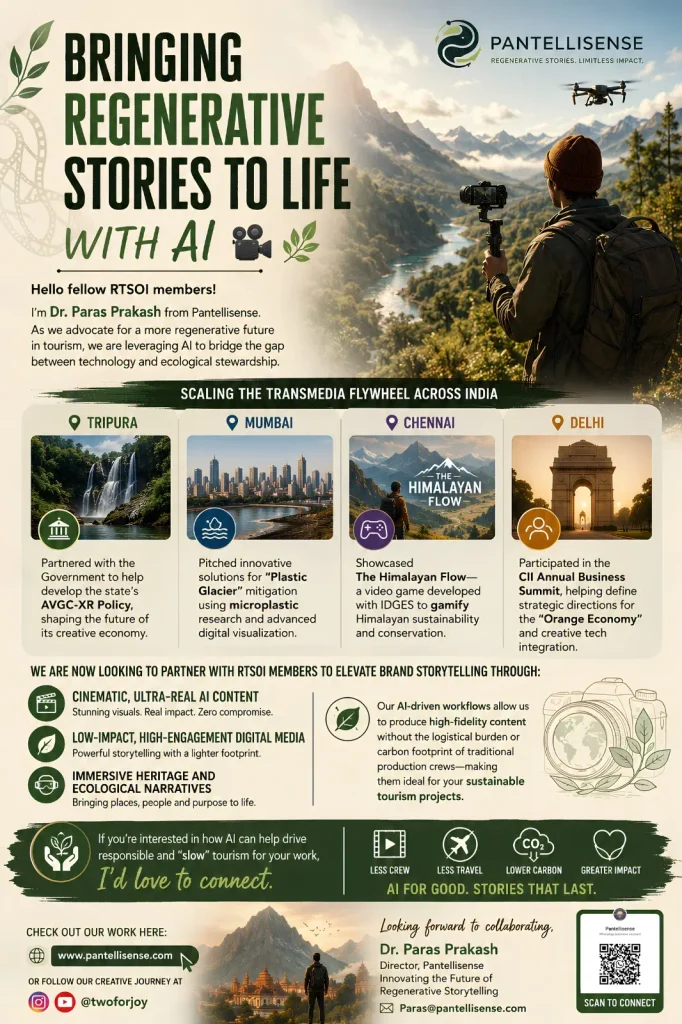
Pantellisense’s Transmedia Flywheel illustrates this approach by extending stories across films, digital media, interactive experiences, education, gaming, and live events, creating deeper engagement around environmental and cultural themes.
Initiatives such as The Himalayan Flow, a climate-action video game, along with projects like The Last Drop and The Plastic Glacier, demonstrate how technology can make conversations around water conservation, climate resilience, and ecological responsibility more accessible and engaging for diverse audiences.
Innovation Supporting Responsible Tourism Across India
Across the country, collaborations between tourism stakeholders, technology innovators, educators, and policymakers are creating new opportunities to advance responsible tourism.
Through engagements with governments, industry forums, educational institutions, and creative communities, organisations like Pantellisense are contributing to conversations around sustainable destination development, conservation, and environmental awareness.
These initiatives reinforce an important message: innovation and sustainability are most effective when they work together to create meaningful impact.
Building Awareness Through Community Initiatives
The Great Himalayan Water Festival further demonstrates how storytelling, culture, and community participation can come together to promote environmental stewardship.
By creating platforms for dialogue around water conservation and ecological resilience, such initiatives encourage local communities, visitors, and tourism stakeholders to become active participants in protecting natural resources.
For responsible tourism, these collaborative efforts represent valuable opportunities to strengthen both environmental awareness and community engagement.
The Road Ahead for Responsible Tourism
As tourism continues to evolve, storytelling will remain central to building more conscious travel experiences. The challenge is no longer simply attracting visitors, but inspiring them to become partners in protecting the destinations they explore.
At RTSOI, we recognise the growing role of innovation in advancing responsible tourism. The work of Dr. Paras Prakash and Pantellisense Pvt. Ltd. demonstrates how Artificial Intelligence can be thoughtfully applied to create stories that educate, inspire, and encourage positive action.
By embracing technology alongside sustainability, the tourism sector can amplify authentic narratives, strengthen environmental stewardship, and build a future where every story contributes to more responsible travel.