
At Karma Lakelands, golf has always been about more than the game. It is about connecting people with nature, creating community, and demonstrating that a golf destination can also be a living example of responsible and sustainable living.
This spirit came alive on 15 August 2026, when Karma Lakelands celebrated India’s 80th Independence Day with a morning that brought together patriotism and environmental stewardship.
The National Flag was proudly hoisted by Radhika Anand, Founder of Plantology, who has personally planted more than half a million trees and follows a zero-waste lifestyle, along with Group Captain Dr S. N. Mishra, associated with climate-change education at TERI.
The morning also marked the dedication of Karma Lakelands’ 1-tonne-per-day Energy Bin Biogas System—a significant step towards a genuinely circular ecosystem.
Turning Waste into Energy
The Energy Bin is built around a simple principle: what is generated within the campus should, wherever possible, become a resource for the campus itself.
Speaking on the occasion, Mr. Ashwani Khurana, Founder, Karma Lakelands, said the biogas system would not only generate clean energy to fire the kitchens of KLUB Karma, but also produce nutrient-rich bio-compost.
Its feedstock includes cow dung from more than 120 cows, food waste generated by approximately 1,500 people eating every day across the staff canteens, and organic waste from residents, hospitality guests and golfers.
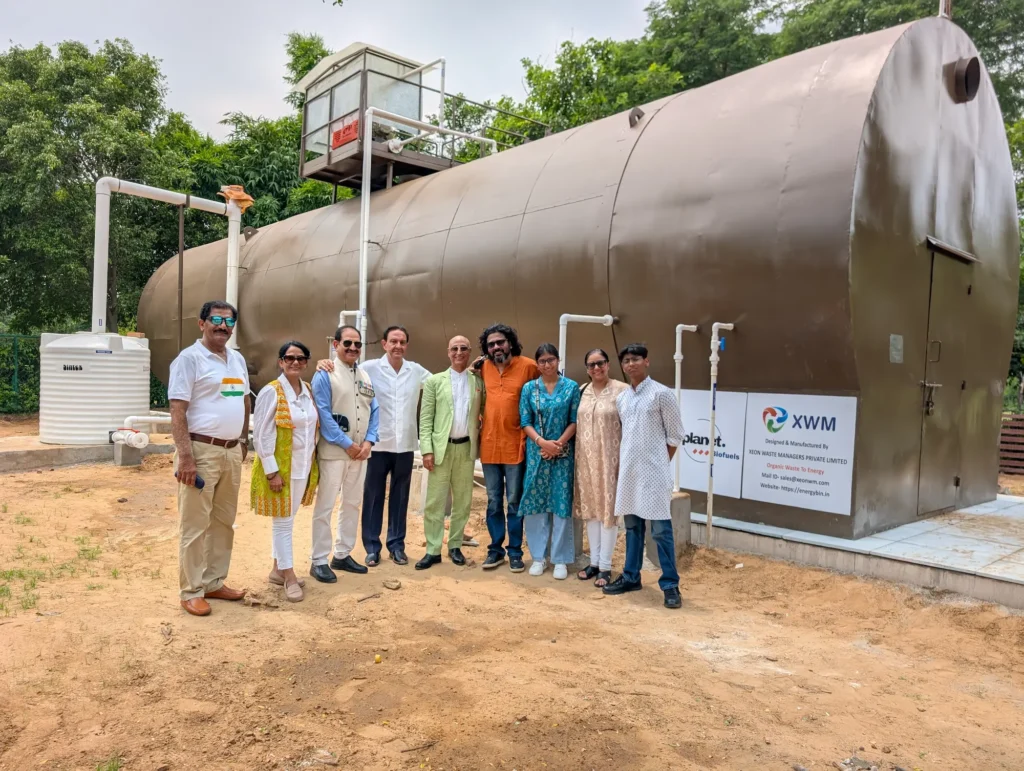
In effect:
Food → Waste → Biogas + Bio-compost → Energy + Soil Nutrition → Food
The Energy Bin is also a precursor to the arrival of Sobha Aranya at Karma Lakelands in the coming years. Sobha Aranya is envisioned as a conscious community that will carry this philosophy into everyday residential living. Once occupied, its biodegradable waste can be segregated at source and channelled into the Karma Lakelands biogas system, where it can be transformed into clean, green energy and bio-compost, rather than ending up as conventional waste.
This creates the possibility of a larger circular ecosystem in which the golf resort, hospitality facilities and resident communities work together in a closed loop, ensuring that every resource is renewed and reused for a truly sustainable future.