
Mr. Niranjan Khatri is a founder member of RTSOI and Former GM Sustainability of ITC Hotels. He pioneered the eco design methodology in Sri Vijayapuram erstwhile Port Blair when he was posted there from 1988 to 1992. The eco design tool kit was shared with the International Labour Organisation (ILO) in 1996. This was shared widely as a toolkit for capacity building programs for the hospitality sector. He also headed the CII Renewable Energy Cell from 1996 to 1997. His article is given below.
Why the green transition is an imperative:
India is a large country with a population of over 140 crores. The country generates 1.5 lakh tons of waste per day. In 2014, Swachh Bharat Abhiyan was announced to tackle the waste emanating from many sources. The country has embraced the circular economy as one of the core principles of managing waste and trying to prevent it from landing in landfill sites, which occupy 1,546 sq. km of prime land on the periphery of many cities and towns. There is no formal system for collecting waste in rural areas; hence, it lies along highways and in empty spaces, and most of the time it is burnt, compromising air quality.
Taking care of waste is every citizen’s responsibility—by reducing waste at the source or repurposing it to derive residual value.
Having given this brief backdrop, Prestige Monte Carlo (PMC), a gated community in Bengaluru, started training voluntary members through an eco-design program to help them understand different environmental challenges such as water, waste, and energy, alongside various dimensions of social challenges. A green team was formed to work on these issues, with the goal of creating future green leaders.
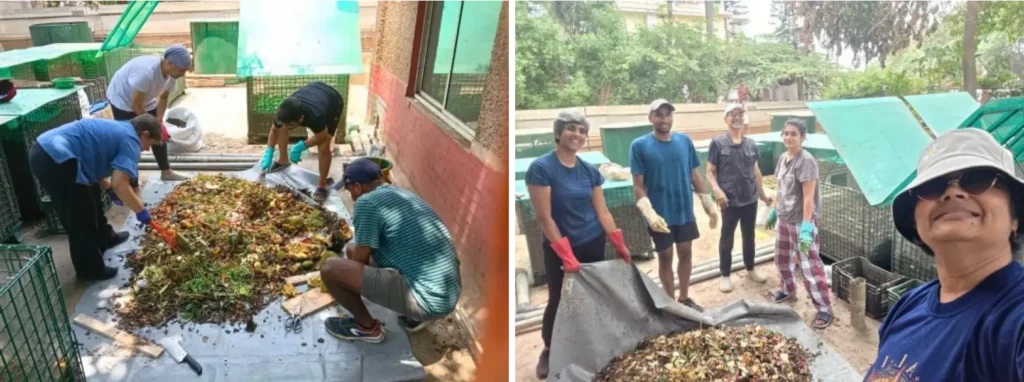
The team has become active and voluntarily takes up tasks on the waste management front whenever the need arises, leading by example.
A few years back, water restrictors were installed in all the taps across every home. The device costs around ₹30 and reduces the flow rate from 9 liters per minute to approximately 2.5 liters per minute.
Many homes have installed dual-flushing cisterns, which reduce water consumption by approximately 75%. In Karnataka, it is mandatory to install Sewage Treatment Plants (STPs); our treated water is used for horticultural purposes. Rain water recharge pits are also already in place, and many more opportunities are being identified for implementation in collaboration with our enlightened community.
Creating value in the community: On the energy front, decoupling from fossil fuels has commenced, as seven of our buildings now have rooftop solar systems. All public area lighting uses energy-efficient lights.
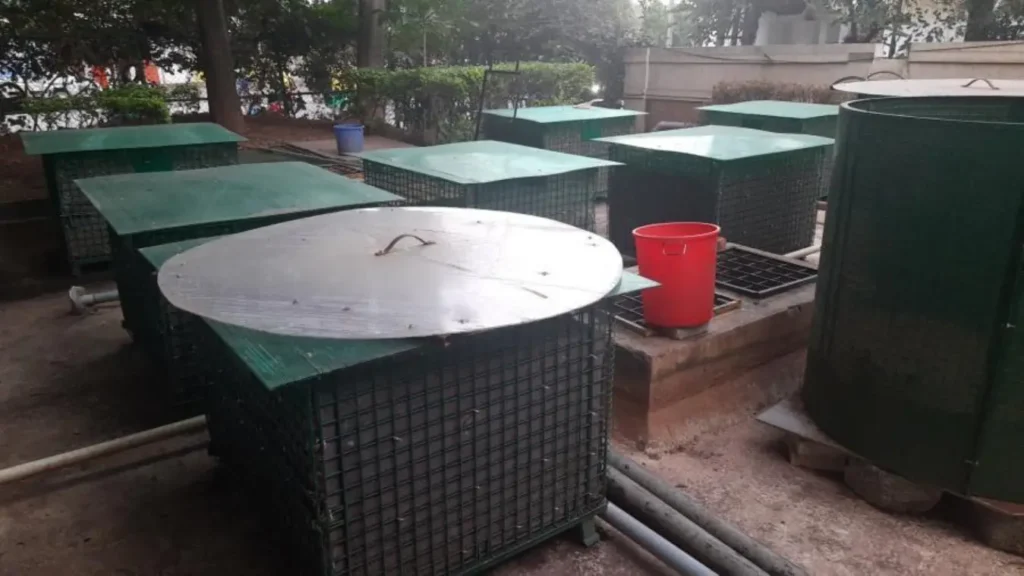
It is said that waste is wealth, or that waste is simply a misplaced resource. Last year, we embarked on a journey to cut our umbilical cord to the city’s landfill sites by handling wet waste in situ. While waste segregation started many years ago, since last year, the entire wet waste of our large community is composted in situ. The resulting compost is used for our gardens and landscaping, and the excess is sold to nearby farmers. By preventing wet waste from reaching landfill sites, we reduce the generation of leachate. A collateral benefit of repurposing wet waste is a reduction in the generation of lethal methane gas from landfills.
Waste has many dimensions; hence, we are engaging with caterers to eliminate the use of paper cups and tissues, asking them to bring reusable plates for parties instead. All the steps we have taken can be easily replicated by other gated communities to navigate toward our country’s zero-waste ambition.
The hospitality industry also has a great opportunity to identify areas of waste and eliminate them from operational systems. Hotels and resorts with available space can install biogas plants to generate gas for cooking—providing a significant cost advantage in an era of rising energy prices. Working toward zero waste ultimately improves any organization’s bottom line.
There are many more areas of waste that can be addressed innovatively. During renovations, people often discard pieces of wood and marble slabs, which can be reused within the complex. We made a large meeting room table from discarded wood, and used marble slabs to build mini-ramps for rolling waste bins smoothly toward the composters.
Similarly, discarded pipes were repurposed into leaf composters for the community. Construction and demolition (C&D) waste remains the elephant in the room; handling this effectively requires innovative city-wide C&D collection systems to convert waste into bricks and other materials for large-scale construction.
In conclusion, I would like to quote: “Chakram ekam na vartate”—the wheel does not move on its own; it has to be aligned with different stakeholders. Bearing this in mind, extra ornamental plants not required in our complex are gifted to a new factory to beautify their facility.
Similarly, mango seeds collected from our residents are sent to Dr. Jasmit Singh Arora in Kolkata. He grafts them into saplings and distributes them to marginalized farmers in Jharkhand and Bihar—an excellent example of upcycling mango seeds to create an additional revenue stream for farmers.